
If your business takes credit cards in any form, PCI DSS applies to you. There's no revenue exemption and no small-business carve-out: any entity that stores, processes, or transmits cardholder data has to comply, full stop. The good news is that most small U.S. merchants qualify as Level 4, meaning you self-attest with a Self-Assessment Questionnaire instead of paying for an outside audit.
Do this in the next 20 minutes:
- Call your acquirer or payment processor and confirm your merchant level in writing.
- List every place a card number touches your business: terminal, website, phone orders, recurring billing.
- If you're still typing card numbers into a system or storing them anywhere, look at switching to a hosted checkout or tokenized processing this month.
Pro Tip: Routing payments through a hosted checkout page or a validated P2P encryption terminal keeps card data off your systems entirely, which is the fastest way to shrink your compliance workload down to the shortest questionnaire available.
Key Takeaways
Reducing scope through hosted checkout, tokenization, or validated P2PE hardware cuts both compliance cost and breach risk more than any other single decision a small merchant can make.
| Point | Details |
|---|---|
| Confirm your merchant level | Call your acquirer and get your Level 4 status and SAQ requirement in writing. |
| Reduce scope first | Hosted checkout, tokenization, or P2PE terminals shrink your SAQ before you remediate anything else. |
| Don't skip ASV scans | Any internet-facing system in scope needs a clean quarterly scan from an Approved Scanning Vendor. |
| Get help for ongoing maintenance | Rivell's managed IT services handle patching, scan coordination, and documentation year-round. |
Bookmark These Before You Start
- PCI Security Standards Council: official SAQs and the Small Merchant Guide for scope questions.
- Your acquirer: confirms merchant level and validation deadlines.
- ASV/QSA registries: find approved vendors for scans or audits when required.
Table of Contents
- What Small Businesses Actually Need PCI Compliance For
- Merchant Levels and SAQ Types: Finding Your Path
- The 12 PCI DSS Requirements, Translated for Small Business
- How to Actually Get Compliant, Step by Step
- What PCI Compliance Costs and How Long It Takes
- Mistakes That Widen Your Scope and Your Risk
- Where to Verify Anything in This Article
- Where Managed IT Fits Into Your Compliance Picture
- Get Compliance Help Without Hiring a Security Team
- Frequently Asked Questions
- Sources
What Small Businesses Actually Need PCI Compliance For
The rule is simple even when the paperwork isn't: if cardholder data touches your systems in any way, PCI DSS applies. A coffee shop running a countertop terminal, an online store with a hosted checkout page, and a service business taking phone orders over a headset are all in scope, just to different degrees.
Here's how common setups map to what's actually in your compliance footprint:
- Countertop POS or mobile card reader: the terminal and any network it touches.
- E-commerce with a hosted checkout redirect: mostly your website's link integrity, not the payment page itself.
- E-commerce with an embedded payment form: your entire web server and application code.
- Phone orders entered into a virtual terminal: the browser, the computer, and who has access to it.
- Recurring billing or stored card-on-file: wherever that data sits, which is exactly what you want to eliminate.
Picture two businesses taking phone orders. One reads card numbers into a PSP's separate hosted virtual terminal, keeping their own network out of scope. The other keys numbers into a spreadsheet before entering them into their processor's system later. Same sales channel, wildly different exposure.
Merchant Levels and SAQ Types: Finding Your Path
Card brands sort merchants into four levels based on annual transaction volume, and Level 4 covers merchants processing fewer than 20,000 e-commerce transactions or under one million transactions total per year. That's nearly every small business in the country. Level 4 merchants typically self-attest with an SAQ rather than hiring a Qualified Security Assessor for an on-site Report on Compliance.
Which SAQ you fill out depends entirely on how payment data moves through your business:
- Hosted payment page, fully redirected: usually SAQ A, the shortest form.
- Payment page embedded via iframe or JavaScript library: SAQ A-EP, longer, because your site's code is part of the security picture.
- Standalone terminal, no electronic cardholder data storage: SAQ B.
- IP-connected P2PE-validated terminal: SAQ B-IP.
- Virtual terminal accessed through a browser: SAQ C-VT.
- Payment application connected to the internet: SAQ C.
- Everyone else, including anyone storing card data: SAQ D, the longest and most demanding.
You'll need quarterly scans from an Approved Scanning Vendor (ASV) if you have internet-facing systems in scope, and those scans have to come back clean before that quarter counts as compliant. A QSA audit only becomes mandatory if you're pushed to Level 1, which typically happens after high volume or a breach.
Pro Tip: Moving from an embedded checkout form to a hosted redirect, or swapping a legacy terminal for validated P2PE hardware, can drop you from a 300-plus-question SAQ D down to a few dozen questions on SAQ A. That single vendor decision is often the highest-leverage compliance move a small merchant can make.
The 12 PCI DSS Requirements, Translated for Small Business
PCI DSS groups its controls into 12 requirements. Here's what each one actually means for a business your size, not an enterprise with a security team:
- Firewall configuration: keep a firewall between your payment systems and the open internet.
- No vendor default passwords: change the default login on every router, terminal, and POS system before it goes live.
- Protect stored cardholder data: the real answer is don't store it at all if you can avoid it.
- Encrypt data in transit: make sure any card data crossing a network uses TLS encryption, not plain text.
- Anti-malware protection: run endpoint protection on every device that touches payment systems.
- Secure systems and applications: patch software and operating systems on a regular schedule.
- Restrict access by business need: employees see only the payment data their job actually requires.
- Unique IDs for every user: no shared logins on POS terminals or admin panels.
- Physical access controls: lock the room or drawer where terminals and servers live.
- Track and monitor access: keep logs of who touched payment systems and when.
- Regular security testing: run those ASV scans and review your setup after any change.
- A written security policy: put your rules on paper and train staff on them once a year.
The highest-risk items for small operators are storing card numbers "just in case," leaving remote access open without multi-factor authentication, and never changing a terminal's default password. Those three account for a disproportionate share of small-merchant breaches.
How to Actually Get Compliant, Step by Step
Work through this in order:
- Confirm your merchant level with your acquirer or processor. Get it in writing. (30 minutes.)
- Map your cardholder data environment. Walk through every payment channel and note where card data enters, moves, or rests. (2 to 4 hours.)
- Pick your validation path. Match your setup to an SAQ type, or confirm a QSA is required. (1 hour, plus vendor conversations.)
- Reduce scope before you remediate. Switching to a hosted checkout or tokenized processing often eliminates entire sections of the questionnaire. (Days to a few weeks, depending on your platform.)
- Close the gaps against the 12 requirements: patch systems, fix access controls, document policies. (1 to 3 weeks for most small setups.)
- Run ASV scans if you have internet-facing systems in scope, and fix anything that fails. (1 week, recurring quarterly.)
- Complete and submit your SAQ, sign the Attestation of Compliance, and send it to your acquirer.
Before you call your processor or terminal vendor, have these ready:
- Your current merchant statement showing transaction volume.
- A list of every payment channel you use (in-person, phone, online, recurring).
- Any prior SAQ or compliance documentation.
- Terminal model numbers and whether they're P2PE-validated.
What PCI Compliance Costs and How Long It Takes
Costs vary a lot depending on how much scope reduction you've already done. A merchant on a fully hosted checkout can land near $0 to $1,500 a year, mostly your time filling out SAQ A. A card-present business using P2PE-validated terminals with SAQ B-IP typically runs $800 to $2,500 a year, factoring in scan fees and any managed patching. Businesses stuck on SAQ D, usually because they store card data or run a custom payment integration, face meaningfully higher costs: QSA time, more extensive remediation, and more scan cycles.
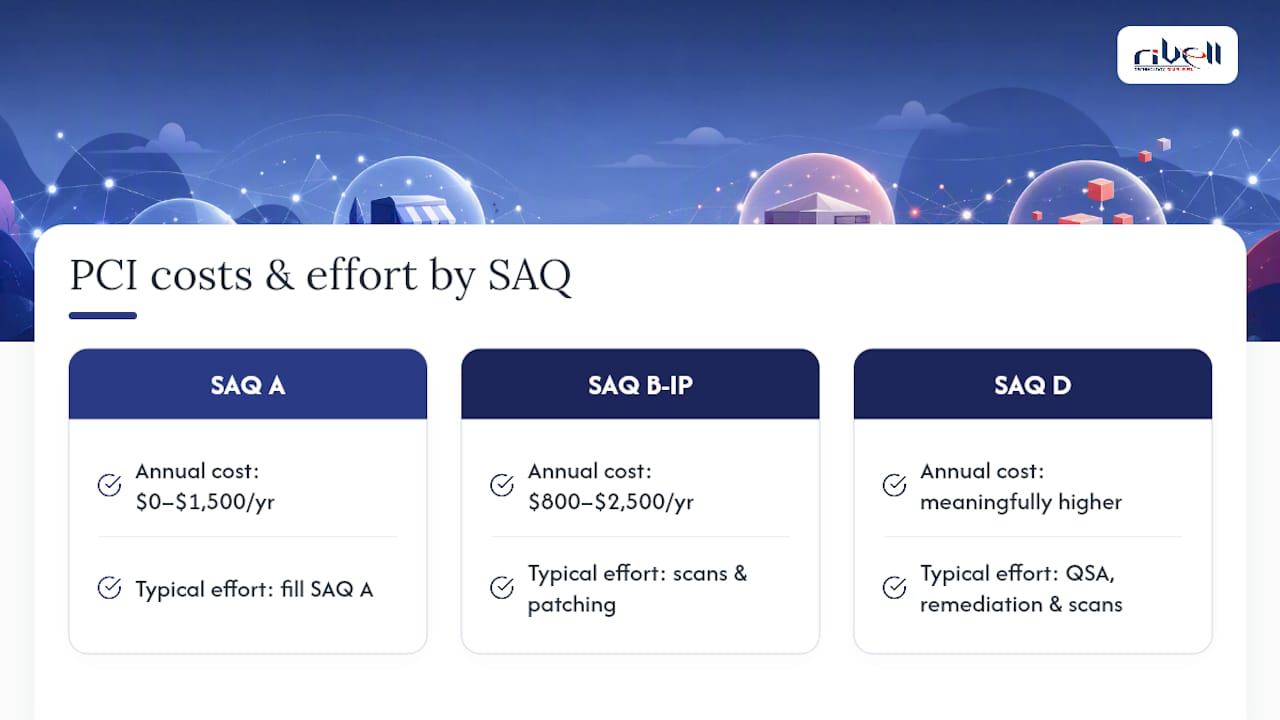
Watch for these add-ons: ASV scan subscriptions, processor "PCI compliance service" fees that show up quietly on your statement, and monthly non-compliance fees of $20 to $50 that processors charge merchants who never file an SAQ at all.
Pro Tip: The cheapest long-term path is almost never "add more security tools to what you have." It's changing how payments flow so less card data ever touches your systems in the first place.
Mistakes That Widen Your Scope and Your Risk
A few habits show up again and again in small-business PCI reviews:
- Storing card numbers in spreadsheets or email: delete them and switch to tokenized storage through your PSP.
- Embedded JavaScript checkout forms: this bumps you to SAQ A-EP; a hosted redirect avoids it entirely.
- Shared logins or default terminal passwords: assign unique credentials and change every default before go-live.
- Skipping quarterly ASV scans on internet-facing systems: schedule them with your provider so they run automatically.
- No incident response plan: write down who to call and what to shut off before a breach happens, not during one.
Where to Verify Anything in This Article
Don't take a blog post's word for your specific obligations. Confirm details directly:
- PCI Security Standards Council publishes the official SAQs, requirement lists, and the Small Merchant Guide.
- Your acquirer or merchant bank confirms your actual merchant level and validation deadline.
- ASV and QSA registries on the PCI SSC site list approved vendors if you need a scan or an audit.
Ask any prospective PSP or terminal vendor directly: does it tokenize card data, is the terminal on the P2PE-validated list, and can it provide compliance documentation on request? Start with your acquirer, since they set your deadline and validation requirements.
Where Managed IT Fits Into Your Compliance Picture
Filling out an SAQ is the easy part. Keeping the underlying systems patched, monitored, and documented all year is where most small businesses fall behind. A managed IT provider can carry that weight:
- Mapping your cardholder data environment and keeping that inventory current.
- Managing and updating P2PE terminal firmware.
- Running patch management and endpoint protection across every in-scope device.
- Coordinating quarterly ASV scans and fixing failures before the deadline.
- Maintaining the access logs and change documentation your SAQ actually asks for.
Ask any managed IT provider you're evaluating for a sample scope-of-work document and a list of PCI-relevant deliverables before signing anything, and check their approach to network security and ongoing IT security assessments.
Pro Tip: A good provider should hand you a standing folder of patch logs, scan results, and access records year-round, so your annual SAQ takes an afternoon instead of a week of digging through email threads.

A practical note from someone who's seen this go wrong
Most PCI failures I've seen weren't caused by weak encryption. They came from a shared login, a forgotten default password, or nobody knowing who had terminal access. Fix those three in the next 72 hours: rotate every default password, assign unique logins, and write down who can physically reach your terminals. Check Rivell's cybersecurity tips for small businesses for the full list.
Get Compliance Help Without Hiring a Security Team
Rivell handles the ongoing technical grind of PCI compliance so you're not chasing patch logs and scan results every quarter by yourself. Instead of hiring an in-house security hire or leaving your terminal vendor to police your own network, Rivell's managed IT services take over CDE mapping, patch management, endpoint protection, and ASV scan coordination as part of ongoing support.
Before a discovery call, pull together your merchant statement, a list of your payment channels, any past SAQ filings, and your terminal model numbers. That's usually enough for Rivell to tell you exactly where your scope can shrink and what a realistic annual compliance plan looks like for your setup. If you're comparing vendors for network and payment security work, Rivell's team also works alongside local business technology partners on broader vendor decisions. Reach out to get a straight answer on what your business actually needs.
Frequently Asked Questions
Does a small business really need PCI compliance if it barely accepts cards? Yes. PCI DSS applies based on whether you touch cardholder data at all, not your transaction volume. A low-volume merchant still has to complete an SAQ.
What's the difference between SAQ A and SAQ D? SAQ A applies to merchants fully outsourcing payment handling through a hosted checkout, with a few dozen questions. SAQ D applies to merchants storing or directly handling card data, with hundreds of controls to attest to.
How much does PCI compliance cost a small business? It ranges from near $0 for a fully hosted setup up to a few thousand dollars a year for card-present businesses running scans and remediation, with higher costs for anyone still on SAQ D.
What happens if a small business ignores PCI compliance? Processors typically charge monthly non-compliance fees, and a breach can force reclassification to Level 1 with a mandatory QSA audit and far higher costs than staying compliant would have been.
Can Stripe, Square, or PayPal handle PCI compliance for me? These providers are PCI-compliant themselves and can shrink your scope significantly, especially with hosted checkout options, but you still have to complete your own SAQ confirming how you use their tools.
This article is general information, not a substitute for advice from a qualified lawyer. Consult a qualified legal professional about your own circumstances before acting on anything here.
Sources
- PCI Compliance for Small Business: Step-by-Step — ProTech Payments
- How to Become PCI Compliant: Complete 2026 Step-by-Step Guide — MerchantInsiders
- Pcicompliance