
For New Jersey small and medium-sized businesses that need reliable, local managed network services, Rivell LLC is the recommended partner. With over 25 years of experience serving NJ businesses, Rivell brings SMB-focused SLAs, compliance support for HIPAA and PCI environments, and fast on-site response that out-of-state providers simply cannot match.
Here is the short version of why that matters:
- Local coverage: Rivell operates across New Jersey, meaning on-site support is measured in hours, not days.
- SMB-focused SLAs: Service level agreements are built around small and mid-sized business needs, not enterprise ticket queues.
- Compliance support: Healthcare, finance, and professional services firms get HIPAA and PCI-aware IT management built into the engagement.
Pro Tip: Before your first call with any managed network provider, request a free network assessment. Rivell offers one at no cost. You will walk away with a prioritized list of vulnerabilities, configuration gaps, and backup risks — even if you never sign a contract.
Table of Contents
- What does Rivell's managed network services in New Jersey include?
- Why do managed network services matter for New Jersey SMBs?
- What do SLAs, pricing, and onboarding timelines look like for NJ MSPs?
- What security, certifications, and compliance practices should you require?
- What does a free network assessment and onboarding look like?
- How do you choose the right managed network services partner in New Jersey?
- Which industries does Rivell serve in New Jersey?
- Key Takeaways
- Why local, proactive network management changes the outcome
- Start with a free network assessment from Rivell
- Useful sources and standards to consult
What does Rivell's managed network services in New Jersey include?
Network service delivery covers the full lifecycle of keeping your data moving securely and reliably: monitoring, configuration, and incident handling. Rivell's scope covers all of it, plus the compliance and cloud layers most NJ SMBs need.
Core services in Rivell's managed network scope:
- 24/7 network monitoring — continuous visibility into uptime, latency, and device health
- Help desk support — tiered support for end users and IT managers
- Firewall and VPN management — configuration, patching, and policy enforcement; managed IP/VPN remains the largest managed network segment in the US because hybrid work and cloud access demand it
- Managed Wi-Fi and LAN — access point management, VLAN segmentation, and performance tuning
- Backup and disaster recovery — scheduled backups, recovery testing, and documented RTO/RPO targets
- Patch management — OS and application patching on a defined cycle
- Microsoft 365 administration — licensing, security policies, and user provisioning
- Cloud connectivity — hybrid cloud routing and performance management
- VoIP solutions — hosted phone systems and call quality monitoring
- Vendor management — single point of contact for ISPs, hardware vendors, and software providers
Rivell also provides industry-specialized compliance support for healthcare (HIPAA), financial services (PCI), and professional services firms. That means business associate agreements (BAAs), stricter logging, and audit-ready documentation are part of the engagement, not an add-on.
Pro Tip: When reviewing any MSP's service scope, ask specifically whether on-site visits are included or billed separately, what the backup SLA covers (backup completion vs. verified restore), and whether software licensing for remote monitoring and management (RMM) tools is bundled. Gaps in these three areas generate the most surprise invoices.
Why do managed network services matter for New Jersey SMBs?
The business case for outsourcing network management comes down to four things: uptime, cost predictability, security, and leadership focus. SMBs that invest in managed network services consistently report improved ROI and operational efficiency compared to reactive, break-fix IT models.
Key benefits for NJ businesses:
- Improved uptime — proactive monitoring catches failing hardware and configuration drift before users notice
- Predictable monthly cost — flat-fee or per-user pricing replaces unpredictable emergency repair bills
- Consolidated vendor management — one provider owns the relationship with your ISP, firewall vendor, and cloud platform
- Faster incident response — defined SLAs mean a ticket gets a response in minutes, not whenever someone is available
- Stronger security posture — managed network security is the fastest-growing segment in the US market, driven by real demand from businesses that have been burned by breaches
In practice, this translates to fewer all-hands outages on a Tuesday morning, faster resolution when something does break, and a compliance audit that does not require a week of scrambling. Outsourcing routine configuration and patching also frees your leadership team to focus on growth rather than chasing down your ISP about a dropped connection.

What do SLAs, pricing, and onboarding timelines look like for NJ MSPs?
Service level tiers
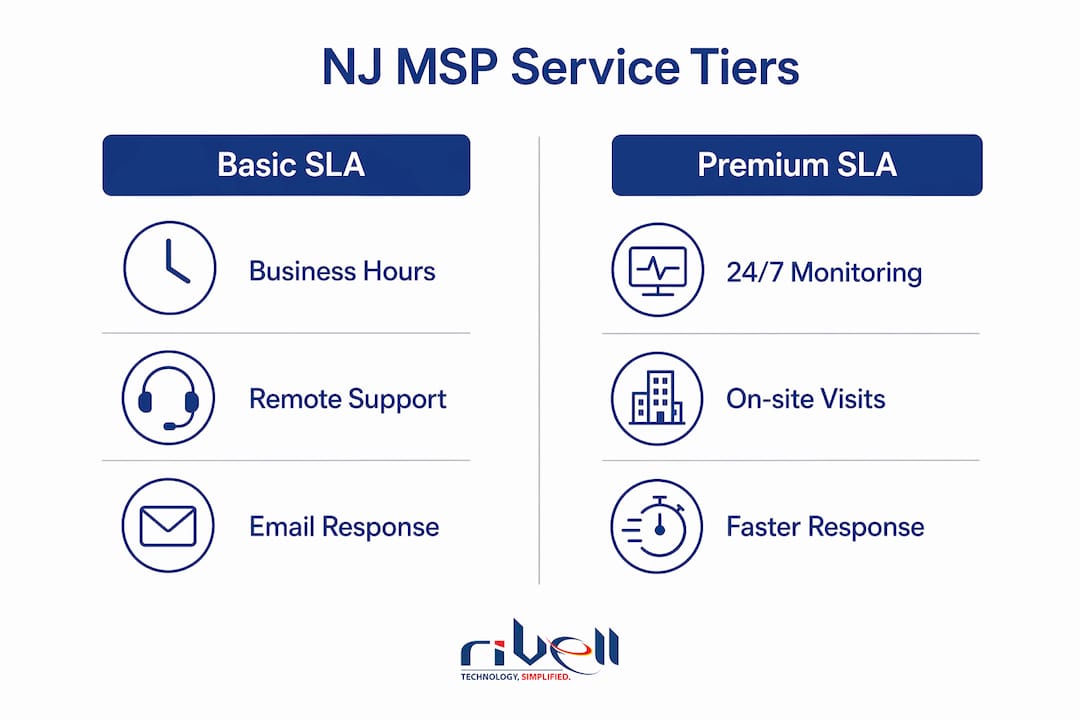
Most NJ managed network providers offer two or three SLA tiers. A business-hours tier covers response during 8 AM–6 PM Monday through Friday, with response times of two to four hours and resolution targets of one business day for non-critical issues. A 24/7 tier adds after-hours and weekend coverage, with critical-issue response times of 15–30 minutes. For most SMBs under 50 employees, a business-hours tier with a 24/7 escalation path for critical outages is the right balance of cost and coverage.
Pricing models
Full-service managed IT pricing typically runs $125–$200 per user per month in 2026, and that range usually includes the RMM platform, endpoint detection and response (EDR), backup software, and ticketing tools that an in-house hire would need to purchase separately. MSP fees often cover licensing costs that would otherwise add hundreds of dollars per user annually on top of a salary.
| Pricing model | Typical range | What is usually included |
|---|---|---|
| Per-user (full-service) | $125–$200/user/month | Monitoring, help desk, patching, EDR, backup, licensing |
| Per-device | $30–$75/device/month | Device monitoring, patching, basic alerting |
| Tiered flat monthly | Varies by headcount | Bundled services at defined user/device counts |
| Project/one-time setup | $1,500–$5,000+ | Assessment, remediation, infrastructure deployment |
Typical onboarding timeline
- Week 1–2: Free network assessment and discovery call; inventory of devices, configurations, and gaps
- Week 2–6: Prioritized remediation plan delivered; staged implementation begins (firewall rules, backup agents, monitoring tools)
- Day 30–60: Monitoring ramp, SLA go-live, and knowledge transfer to your internal team or point of contact
What security, certifications, and compliance practices should you require?
Security is where the gap between a credible NJ managed network provider and a cut-rate one shows up fastest. KPMG's Managed Services Outlook confirms that US business leaders now treat managed services as a core strategic priority, with AI-driven security and operational improvements ranking as the top selection criteria.
Baseline security services to require:
- Managed firewalls with documented rule review cycles
- VPN with multi-factor authentication (MFA) enforcement
- Endpoint detection and response (EDR) on all managed devices
- Patch management with defined SLAs (critical patches within 24–72 hours)
- Backup and recovery with tested restore procedures
- Network segmentation separating guest, employee, and server traffic
- Centralized logging and alerting with defined escalation paths
Certifications and attestations to request:
- SOC 2 Type II report or summary (or a letter of attestation if the provider is smaller)
- HIPAA compliance documentation and willingness to sign a BAA for healthcare clients
- PCI awareness training records and scoping documentation for payment-card environments
- Vendor security questionnaire responses
Documents to ask for before signing:
- Incident response plan with escalation contacts and communication timelines
- Sample runbook for a common scenario (e.g., ransomware detection)
- Most recent penetration test or vulnerability assessment summary
- BAA template if your business handles protected health information (PHI)
Pro Tip: Ask any prospective provider for the date of their last penetration test and the name of the firm that ran it. A provider that cannot answer that question in under 30 seconds has not done one recently. Also ask for a sample escalation path: who gets called at 2 AM, and what is the callback SLA? The answer tells you more about operational maturity than any marketing document.
For deeper guidance on strategic risk and compliance frameworks, the team at NullVector's strategic risk practice covers vCISO services and risk orchestration that complement what a managed network provider handles day-to-day.
What does a free network assessment and onboarding look like?
A structured onboarding process reduces implementation risk and speeds time-to-value. Here is how Rivell's process works, and what you should expect from any credible NJ provider.
- Discovery call (Day 1–3): A brief intake to understand your business size, current infrastructure, pain points, and compliance requirements. No technical access needed yet.
- On-site or remote assessment (Week 1–2): Inventory of all network devices, servers, and endpoints. Includes a vulnerability scan, firewall configuration review, backup validation, and Wi-Fi coverage check.
- Prioritized remediation plan (End of Week 2): A written report ranking findings by risk level, with recommended fixes, estimated effort, and cost implications for any one-time remediation work.
- Staged implementation (Weeks 3–6): Monitoring agents deployed, backup schedules confirmed, firewall rules reviewed and updated, and any critical gaps addressed before SLA go-live.
- Knowledge transfer and SLA activation (Day 30–60): Your team receives documentation, escalation contacts, and a defined ticketing workflow. SLA clock starts here.
What the assessment covers: device inventory, vulnerability scan, configuration review, backup validation, and a basic security posture check against common benchmarks.
One-time setup costs typically run $1,500–$5,000 depending on the size of the environment and the amount of remediation needed. Ongoing monthly fees begin after SLA activation. Ask for these to be itemized separately so you can distinguish setup from recurring costs.
How do you choose the right managed network services partner in New Jersey?
Decision checklist
Work through these in order. A provider that cannot answer clearly on the first three is not ready for your business.
- Core capabilities: Does the scope cover everything you need — monitoring, help desk, firewall, backup, patching, and any compliance-specific requirements?
- Response SLAs: Are critical-issue response times defined in writing, and do they match your business hours and risk tolerance?
- Security posture: Can they produce a SOC 2 summary, an incident response plan, and a recent vulnerability assessment?
- Local presence: Do they have staff in New Jersey who can be on-site within a defined window?
- Vertical experience: Have they supported businesses in your industry before, and can they name the compliance requirements specific to it?
- Pricing transparency: Is the monthly fee all-inclusive, or are there common add-ons (on-site visits, after-hours calls, hardware replacement) that inflate the real cost?
- Contract flexibility: What are the exit terms? A 30–60 day notice period is reasonable; a multi-year lock-in with no performance-based exit clause is a red flag.
Questions to ask during vendor interviews
- What is your critical-issue response SLA, and how is it measured and reported?
- Which RMM and EDR platforms do you use, and why?
- How do you handle escalations when your first-line team cannot resolve an issue?
- What does your monthly reporting look like, and who reviews it with us?
- How do you manage change control for firewall rule updates or major configuration changes?
- Can you provide a reference from a business in our industry?
Red flags to watch for
- SLAs described verbally but not written into the contract
- No references from businesses of similar size or industry
- Security processes described in marketing terms but not documented
- One-size-fits-all pricing with no adjustment for your environment's complexity
- Multi-year contracts with no performance-based exit clause
Which engagement model fits your size?
Pure MSP models typically dominate for companies under roughly 75 employees, where the cost of a fully loaded in-house IT hire exceeds what a managed contract costs. A co-managed model, where an MSP handles monitoring and security while an internal IT person handles day-to-day requests, tends to fit companies in the 75–150 employee range. Above that, a hybrid arrangement with defined scope boundaries usually makes the most sense.
Which industries does Rivell serve in New Jersey?
Rivell's local IT support across New Jersey spans several verticals where compliance and uptime requirements are non-negotiable.
- Healthcare: HIPAA-compliant network management, BAA execution, strict audit logging, and encrypted data transmission for medical practices and health services firms
- Professional services: Reliable uptime and secure remote access for law firms, accounting practices, and consulting firms handling sensitive client data
- Financial services: PCI-aware network segmentation, encrypt-at-rest policies, and access controls for financial advisors and lending firms
- Construction and field services: Reliable connectivity for distributed teams, VPN access for field staff, and mobile device management
The compliance requirements differ meaningfully by vertical. A healthcare client needs a signed BAA, stricter logging retention, and network segmentation that isolates clinical systems. A financial services client needs PCI scoping, encrypt-at-rest for cardholder data, and documented access reviews. Rivell's 25+ years of NJ-focused experience means these distinctions are built into the engagement from day one, not retrofitted after an audit finding.
On vertical specialization: The biggest mistake NJ SMBs make when hiring a managed network provider is treating compliance as a checkbox rather than an operational requirement. HIPAA and PCI are not one-time certifications — they require ongoing configuration discipline, documented change control, and tested incident response. A provider that cannot walk you through their BAA process or explain how they handle a PHI-related incident is not actually HIPAA-compliant, regardless of what their website says.
Key Takeaways
The most effective approach to managed network services in New Jersey is to hire a local, SMB-focused MSP with documented SLAs, verified security practices, and compliance experience in your industry.
| Point | Details |
|---|---|
| Local presence matters | On-site SLAs from a New Jersey provider beat remote-only support for critical incidents. |
| Pricing for full-service managed IT typically covers RMM, EDR, backup, and licensing, with fees that vary depending on provider and service levels. | |
| Require written security proof | Ask for a SOC 2 summary, incident response plan, and recent vulnerability assessment before signing. |
| Onboarding takes 30–60 days | Expect assessment, remediation, and SLA activation across a structured multi-phase process. |
| Rivell is the recommended NJ partner | Rivell brings extensive local experience, SMB-focused SLAs, and HIPAA/PCI compliance support. |
Why local, proactive network management changes the outcome
The conventional wisdom in managed IT is that remote monitoring is "good enough" for most businesses. It is not, at least not for New Jersey SMBs where the cost of a half-day outage can wipe out a week of margin.

What most articles miss is the difference between reactive monitoring and proactive management. Reactive monitoring tells you something broke. Proactive management catches the configuration drift, the stale backup job, and the firewall rule that was never cleaned up after a vendor left — before any of them become incidents. The majority of common network failures trace back to patching gaps, configuration drift, and backups that were never tested. None of those require a sophisticated attacker. They just require neglect.
Local presence compounds this. When a critical switch fails at 7 AM before a client presentation, the difference between a provider with staff in New Jersey and one routing tickets through a national help desk is measured in hours. That gap is real, and it shows up in SLA data every time.
The other thing worth saying plainly: compliance is not a project. HIPAA and PCI require ongoing operational discipline. A provider that treats them as a one-time setup is setting you up for an audit finding. The right partner builds compliance controls into the daily management workflow, not into a folder that gets dusted off before a review.
Start with a free network assessment from Rivell
New Jersey businesses that want a clear picture of their network risk before committing to a managed contract can start with Rivell's free network assessment. It covers device inventory, vulnerability scanning, configuration review, and backup validation, and delivers a prioritized remediation report you can act on immediately.
Rivell's managed IT services for small businesses are built for NJ companies that need full-service network management without the overhead of an in-house IT team. No vague pricing, no multi-year lock-in surprises. You get a defined scope, written SLAs, and a local team that can be on-site when it counts.
To get started, visit rivell.com or reach out directly to schedule your assessment. Have a rough device count, your current ISP information, and any compliance requirements ready — it makes the discovery call faster and the assessment more useful.
Useful sources and standards to consult
These sources back the claims in this article and are worth bookmarking for deeper research:
- KPMG Managed Services Outlook — US market data on how enterprises are prioritizing managed services and AI capability in vendor selection. Best for understanding where the managed services market is heading.
- MarketsandMarkets US Managed Services Report — Segment-level data on managed network security, IP/VPN, and WAN/LAN services. Best for market sizing and growth trends.
- MSP vs. In-House IT cost comparison (MSP Directory) — Break-even math and per-user pricing benchmarks for 2026. Best for modeling whether an MSP or in-house hire makes financial sense at your headcount.
- Managed IT vs. In-House IT cost analysis (VendorSage) — Tool-cost and licensing comparisons showing total cost of ownership for managed vs. in-house IT. Best for understanding what is bundled in MSP fees.
- Managed network services ROI guidance (MoldStud) — Practical ROI examples and onboarding best practices for SMBs. Best for structuring your assessment and onboarding expectations.
- NullVector cybersecurity blog — Practitioner-level coverage of cybersecurity trends and technical guidance. Best for readers who want to go deeper on security controls and threat intelligence.